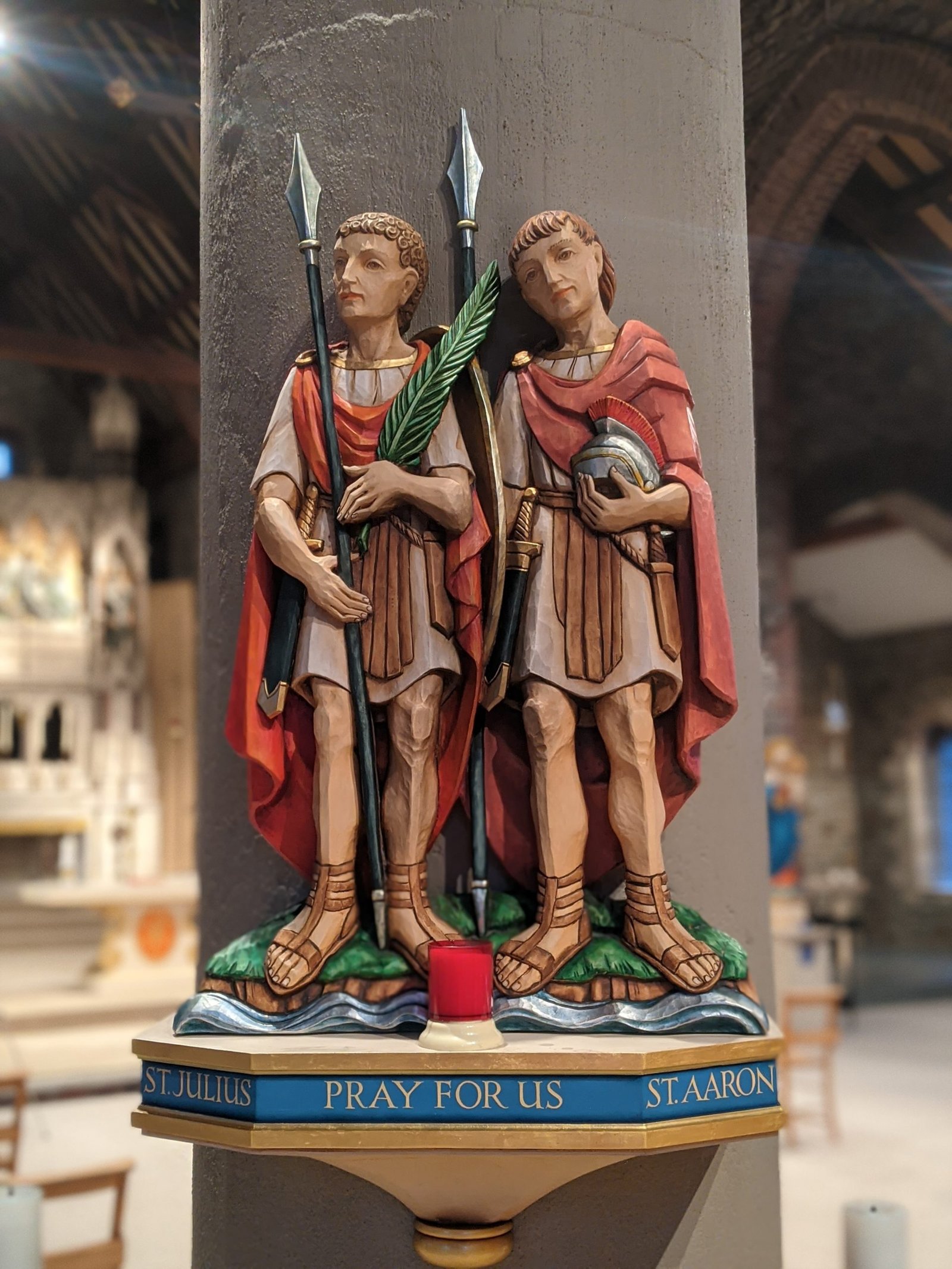
Although details of the lives of Julius and Aaron are denied us, there is ample evidence of their existence and martyrdom, for they are mentioned by several authentic writers of great antiquity, such as Constantius of Lyons (500 AD), Venantius Fortunatus (530–609 AD), the Venerable Bede (731 AD), and Gildas. In “De excidio Britanniae”, published in 544, Gildas says: “God of His own free gift kindled for us bright lamps of holy Martyrs. I speak of St Alban of Verulam, Aaron and Julius, citizens of Caerleon, and the rest who stood firm in Christ’s battle.” Bede writes in his “Ecclesiastical History” in 731: “At that time, Aaron and Julius, citizens of Caerleon, suffered.”
Many historians, seeking an explanation for an early Christian church near Christchurch dedicated to St Alban, have suggested that he either lived at Caerleon or met his death there. This, however, conflicts too strongly with the generally accepted story of Alban’s death, and the better explanation is offered by William Hughes, author of “History of the Church of the Cymry”. Hughes suggests that after Alban’s death at Verulam his companion Amphibalus returned to Caerleon, followed by about a thousand men who, converted to Christianity by Alban’s courageous approach to death, sought to be baptised. The heathen inhabitants of Verulam pursued them to Wales, captured Amphibalus, and put his followers to death. As this great demonstration of Christian fortitude was the outcome of Alban’s martyrdom, it explains why his name should be venerated in this district.
After ten years’ suffering for the Christians, the persecution finally ended when, in 313, Constantine became emperor and, as one of his first acts, granted full liberty to the Christians. And now — to quote Gildas and Bede — “the faithful Christians who during the time of danger had hidden themselves in woods, deserts and secret caves, appearing in public, rebuilt the churches which had been levelled to the ground, founded, erected and finished the temples of the holy martyrs and, as it were, displayed their conquering ensign in all places.”
Christianity was now professed freely throughout Britain and, for some twelve hundred years, the churches of SS Julius and Aaron kept alive the memory of our local martyrs.