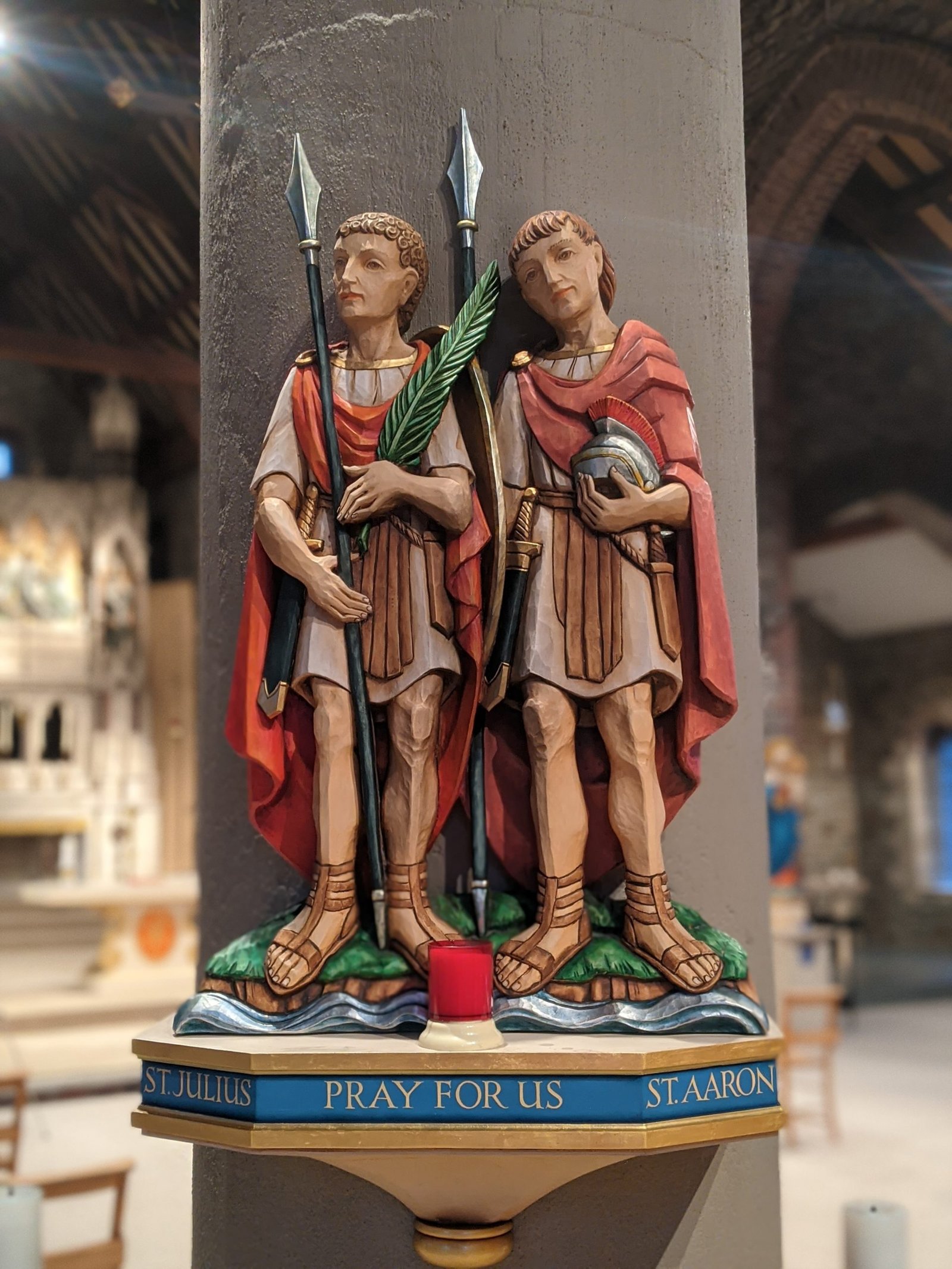
Standing within the bounds of our present parish, let us go back in time some seventeen centuries and try to see the district as it was at the beginning of the fourth century. We are standing within the suburbs of the third greatest city in Britain, Isca Silurum, the City of the Legions, or — to give it its Welsh name — Caerlleon. Looking east from where we stand, we can see, about two miles away, the barracks of the Second Augustan Legion, a garrison of about six thousand soldiers. Outside the barrack walls, stretching west along the river bank past us, are the houses of the civilian population, which numbers about twenty thousand.
Scattered here and there among the houses, palaces and open-air theatres are temples to the pagan gods of the Romans and the Britons, with, occasionally, a small wooden Christian church. These are not easy days for the small band of people who have sworn to follow Jesus Christ, for the Roman Empire regards with uneasy suspicion this new religion which has spread abroad from Palestine, and it does not enjoy the tolerance with which authority looks upon the many other religions. However, the worst is yet to be, for the mistrust and hostility they now meet is soon to turn to violent and ruthless persecution.
In the year 303 the Emperor Diocletian issued an edict ordering the demolition of all churches, the burning of their books and the removal of all Christians who held public office. Other edicts, which quickly followed, ordered the death of all Christians who would not offer sacrifice to the Roman gods. This persecution lasted for the next ten years, but the Christians of Britain were more fortunate than their brethren in many countries for, after the initial fervour of the first two or three years, the Roman governors in Britain, far from the eagle eye of their wrathful emperor, began to relax their pursuit of the Christians.
The British historian Gildas (544 AD), describing the persecution in Britain, says: “Many British Christians were despatched with diversity of torture and torn limb from limb in a most barbarous and cruel manner; those who escaped the fury of their persecutors retired to the woods and deserts and hid themselves in caves, where they continued confessors till God was pleased to revenge their usage upon their persecutors and afford better times to the church.”
Among the many martyrs who suffered in Britain in the Diocletian persecution were four who are of particular interest to us in this area: our patron saints, Julius and Aaron; Alban, the British proto-martyr; and his companion, the priest Amphibalus, a native of Caerleon. The nationality of Julius and Aaron is not clear, but there is no doubt at all that they were citizens of Caerleon. Some say that they were British, but the more popular belief is that they were Roman soldiers. Rice Rees, in his “Essays on the Welsh Saints”, says: “They appear to have been Romans rather than Britons, which may account for the circumstance of their having passed almost unregarded by the Welsh people.” S. Baring-Gould points out that their feast day occurs in the old Roman martyrology, but is not to be found in the Sarum or York Calendars.