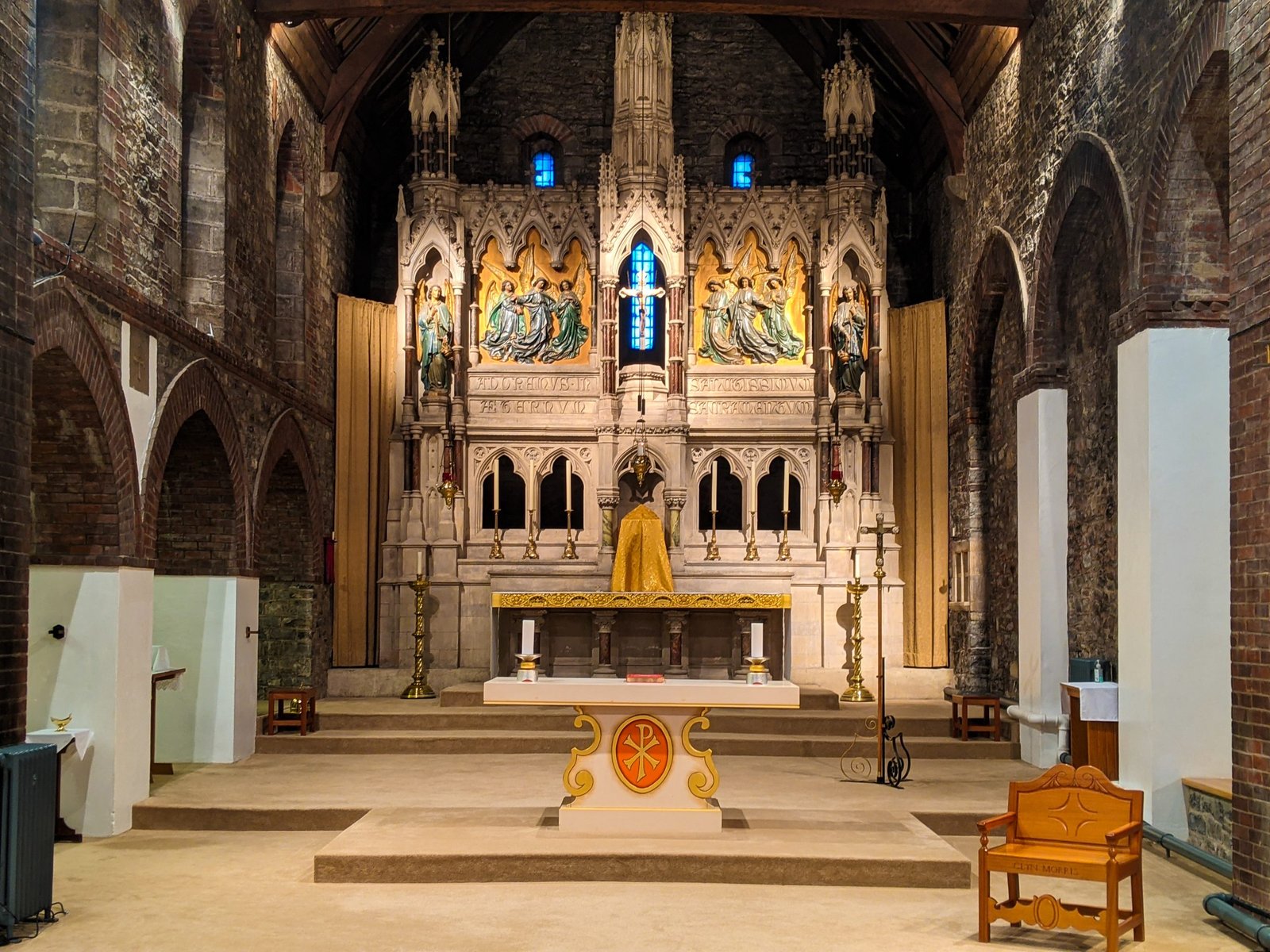
Parish History · 4th Century – 2026
Two Roman martyrs. A living church.
This is the story of two 4th-century martyrs and the 20th-century parish church that bears their names.
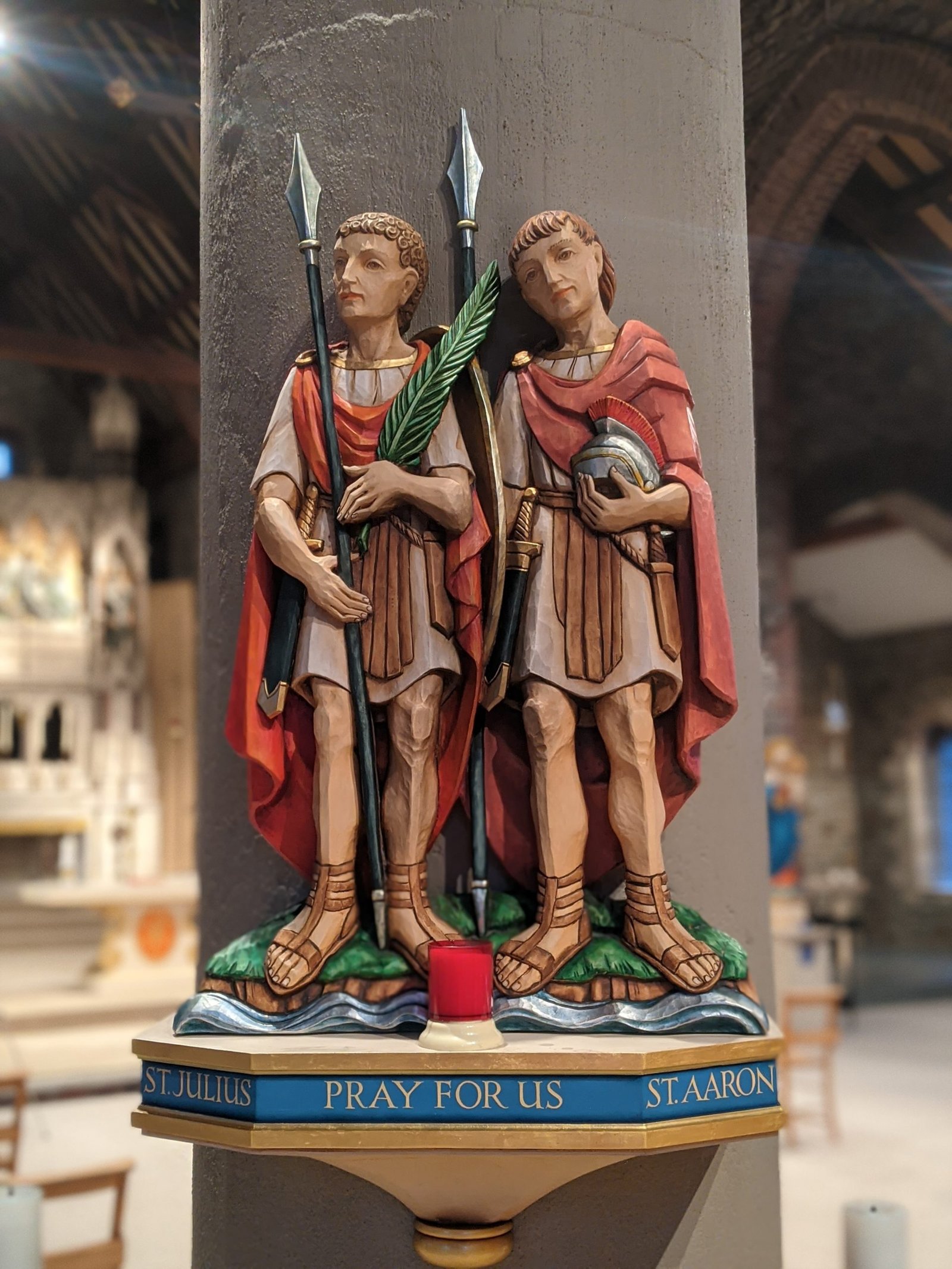
Saints Julius & Aaron — 4th-century martyrs of Caerleon, honoured in St Julian’s Church
Introduction
This is the story of two 4th-century martyrs and the 20th-century church that bears their names. There is little written about our two patrons, Julius and Aaron, beyond a few footnotes in history. However, their example has inspired an active worshipping community through the centuries and culminated in the parish church here standing — an act that in itself was down to a number of inspirational and visionary people through the last 100 years. For those of us who have custody of this building today, it is an immense privilege — but we remain conscious that we have a great responsibility to ensure that both its history and its living witness continue to be heard within and beyond our generation. This Church History is a part of the continued telling of that story — we hope you find it as interesting and inspiring as we do.
The text of this History is based on Basil Reeve’s “St Julius and Aaron Parish Church History and Guide”, published by the Vicar and Churchwardens in 1997. This work in its own right made use of some material from a 1947 publication by Gordon Southheard, revised in 1981, titled “A Parish History”. For reasons of space and economy, some of the historical detail of the 1981 edition did not make it to the 1997 version and this website now allows the fruits of both works to be available for posterity. Both recognised the assistance of others in their production and to that end the foreword and acknowledgements from this source material are reproduced, along with Dr Rowan Williams’ preface (then Bishop of Monmouth).
Preface by Dr Rowan Williams
Then Bishop of Monmouth (September 1997)
Although this beautiful church is only just over seventy years old, it speaks eloquently of a long and varied history. Julius and Aaron, we are told, were among the first to be executed for their Christian faith by the Roman military government, probably at the beginning of the fourth century, and the site of their martyrdom at Caerleon was a spot of enormous significance to local Christians. So we are at once taken back to the earliest days of Christianity in this country. We know too that the present parish was rich in ancient places of worship and dedication up to the Reformation.
Early in this century, the parish was one of those that pioneered the recovery of beauty and dignity in Anglican worship; and it was highly appropriate that it became the resting-place of the stone altar and reredos from what had been the monastic church at Capel-y-Ffin, where, in the nineteenth century, Father Ignatius had attempted to revive the Benedictine life in the Anglican church.
In its fabric as in its worship, the church of St Julius and St Aaron reminds us of the absolute and primary importance for all Christians of witness to the faith, whatever the cost, and of selfless dedication to prayer. Basil Reeve has given us a full and lively account of this much-loved building; and I hope and pray that it will help bring alive to all who read it a sense of the glory and the challenge of the faith that is taught here, a faith as new and as transforming as it was in those early ages of the Church.
With best wishes and prayers, Dr Rowan Williams — Bishop of Monmouth, September 1997.
Foreword & Acknowledgements
In this History and Guide of the Parish and Parish Church of SS Julius and Aaron, the compiler has only touched on past Roman history without going into any great depth and detail. This publication is intended to focus more on the actual history leading up to the founding and building of the Parish Church, from the latter years of the 1800s.
There is ample provision for the reader to learn more about any relevant past Roman history and the Roman martyrs mentioned in this booklet in the local library. Roman artefacts of a religious nature can also be seen in the Caerleon museum.
Further useful reading on the subject can be found in “The Monmouthshire Antiquary”, edited by David H. Williams (various volumes), and “St Julians Newport Gwent (A Parish History)” by Gordon Southheard. Copies of these publications are available in the reading room of the Newport Borough Library.
Acknowledgements
Thanks are due to the following who have helped in some way or other in this compilation either in the work involved or in the supply of information and subject matter used:
Mr Trevor Warren, who supplied all the photographs for inclusion (whose inspiration remains on this site with modern colour photography).
Miss Betty Sage, who supplied factual historical information.
Mrs P. Williams (Pru), who meticulously proofread the manuscript for errors and deserves not only my thanks but the reader’s gratitude for having done so much work to ensure any inaccuracies were eliminated.
Thanks are also due to the Vicar and Churchwardens for allowing access to church records and the inventory. — Basil Reeve, Compiler (1997)
Read Chapter by Chapter
The Story of SS Julius & Aaron
Ch. 01 · AD 303 – 313 Early Christianity & Persecution
Roman Caerleon (Isca Silurum), the Second Augustan Legion, and Emperor Diocletian’s ruthless ten-year persecution of early British Christians.
Ch. 02 · AD 304 – 313 The Three Martyrs
How Gildas, the Venerable Bede, and ancient chronicles preserve the witness of Saints Julius, Aaron, and Alban — “bright lamps of holy Martyrs.”
Ch. 03 · 4th – 12th Century Growth of the Church
Bishop Adelfius of Caerleon at the Council of Arles (314 AD), the Book of Llandaff, and the chapels of Julius and Aaron under Goldcliff Priory.
 Ch. 04 · 6th – 13th Century
The Primacy of Caerleon
Giraldus Cambrensis’s portrait of Caerleon’s three great churches, St David’s translation of the see to Menevia, and medieval Welsh church life.
 Ch. 05 · 1424 – 1840
Destruction, Decline & St Julian’s Manor
The great storm of 1424, Henry VIII’s dissolution of monasteries, Sir George Herbert’s manor, and Newport’s explosive growth to 40,000 people.
Ch. 06 · 1868 – 1882 The Guild of St John the Baptist
The Oxford Movement arrives in Newport, the 1868 Victoria Hall controversy, abolishing Pew Rents, and the first Catholic Mass in Barnardtown.
 Ch. 07 · 1891 – 1901
The Iron Church on Durham Road
A travelling iron chapel opens as “St Julian’s Church” in December 1891 — and endures a turbulent first decade of seven clergy in ten years.
Ch. 08 · 1901 – 1926 Fr John Albert Cottrell & Building Our Church
A visionary young curate plants vibrant Catholic worship, overcomes fierce opposition, and builds the permanent Parish Church consecrated in 1926.